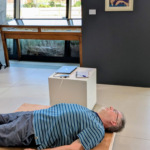
I’ve been reflecting on the way in which I am composing today. It is quietly radical and rather different from my past practice. That was driven by traditional requirements to produce something that had value, expressed in audience terms by appreciation, in commercial terms by transactions, in critical terms by evaluation, and in academic terms by metrics. Both my artistic and academic identity and my financial stability depended on success in those areas. However, retirement in October 2024 has liberated me from all the imperatives and enabled the evolution of a new approach. It has taken the best part of a year for me to relax enough to be able to do this and, so far, it exists only in a single project: Frog Fizzles. Even within that work, there is a struggle going on, which is the subject of this post.
The traditional feedback loop of musical composition goes: make – present – receive – validate. In other words, I make a piece of music by shaping it and refining it until it is ready to be presented, at which point I invite people’s attention. The proposition is: I made these sounds which I think are worth listening to – now please listen. When people do listen, whether live or recorded, validation is sought in the form of positive reactions, purchases, or that explosive gesture of banging one hand into another, thereby drawing on a shared prehistory of early hominid behaviour that expresses appreciation. In fact, the whole process appeals to something very deeply rooted in human evolution: the need to impress one another.
From my point of view as a composer, the process carries with it authorship, responsibility, completion and evaluation, in other words: the complete package of productivity that indicates value. Without that, the reasoning goes, what is the point? What can be created that has value outside of that transaction?
This has been a recurring theme during the creation of Frog Fizzles, the project that I have been working on daily since November 21st 2025. The enormous amount of labour it involves (and will continue to involve in the future) is not necessarily evident in the finished result, and in fact may never be visible at all.
This is not at all a traditional musical composition. There is, of course, a history of practice that challenges notions of presentation and authorship, but Frog Fizzles has emerged for me from a different set of conditions. In particular, it does not begin from a desire to dispense with presentation, but from conditions in which presentation ceases to be necessary. It sets up a situation and suggests that something may happen, by defining constraints and conditions, by withdrawing control and removing obligation.
On many occasions thus far, I have tried to envisage some kind of traditional manifestation of the work, from an interactive installation to a concert piece, and every time I have rejected the idea when I have realised that these would be totally contradictory to the spirit of fizzles. In other words, I am engaged in a struggle with my training, with musical culture, and with expectation itself. The impulse to present, to be received and validated, is extraordinarily powerful and yet I have resisted it, by relinquishing control over the outcome, by trying not to worry about visibility, by aiming to avoid confirmation that it has “worked”.
None of this means that I have given up composition. In the past, the composition was the piece. In Frog Fizzles, the composition is not the piece but a system of relations between mappings, constraints, durations, permissions, and so on. Previously, composition took place before performance. In Frog Fizzles, composition is ongoing, distributed and incomplete. To put it simply: Frog Fizzles is a work that does not depend on being realised.
What does this actually look like in practice? When I presented it in a talk to the Making Music Research Cluster at the University of Leeds, I had them look at a frog and identify some aspect of it to which they could respond. Then, without making a sound, I invited them to imagine a sonic or somatic response. I gave them 10 seconds or so. Immediately after this exercise, there was a sense of joy in the room, a realisation of what a fizzle is, and pleasure at the lack of demand, the denial of productivity. There was no sound, no performance, no artefact, and yet the work clearly occurred and everybody there knew it.
This does not mean I’ve completely abandoned the old way of composing (two of my pieces are appearing on CDs to be released this year), but now I have also composed a system rather than just using a system to compose a piece. I’m no longer making things only to be heard. I’m creating conditions in which listening can take place. Of course, this has emerged from the state of my own hearing, which makes listening to music quite uncomfortable and renders applause intolerable. It is a creative response to the realities of my own current abilities.
What feels difficult is not just habit: I am stepping outside a deeply embedded assumption that music exists to be presented. I am discovering instead that it can exist as something that may or may not occur. This is not a retreat from composition – it’s an expansion of it.
Discover more from Andrew Hugill
Subscribe to get the latest posts sent to your email.