Eastward Oh
Notes
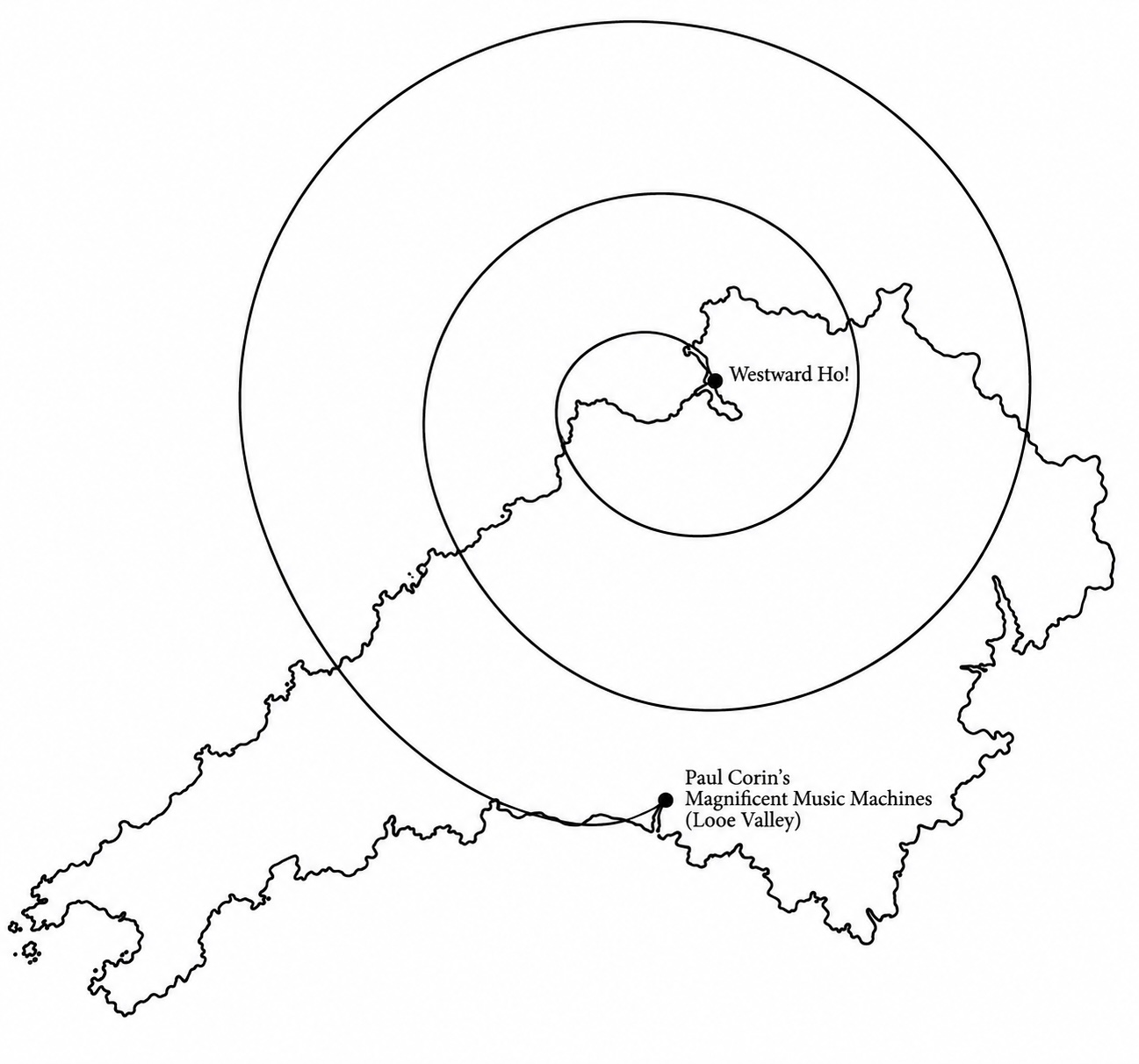
Eastward Oh is a strangely prescient piece. It takes the form of a spiral which I drew on a map of Devon and Cornwall in 1987. The spiral starts in Westward Ho!, on the north Devon coast, and unwinds until it reaches the (now defunct) Magnificent Music Machines, a museum established by Paul Corin in the Looe Valley, Cornwall. The George W . Welch ensemble are the spiral, passing through the same material multiple times but always expanding and transforming it as they go. The solo cello rides this spiral, which passes across a lot of sea as well as land, sometimes being absorbed by it, sometimes emerging from it, and sometimes making a detour. The whole piece becomes gradually more and more romantically expansive and is probably the most directly expressive music I have ever written.
What makes it prescient is that almost a decade later I ended up living in Looe for a time, composing Island Symphony. While there, I began exploring the nascent internet (the World Wide Web barely existed) and thereby met and fell in love with Louise, the woman who was to become my wife. It turned out that she was living in the family restaurant at Welcombe Cross, a location in north Devon that my spiral had passed through on its imaginary journey.
This formal approach represents something of a relaxation of the tighter constraints I had employed in previous works for George W . Welch. Nevertheless, there is still a layer of systematisation, coupled with literary and musical allusions. The title obviously inverts Westward Ho!, but is also an anglicised homophone of Pauline Réage’s erotic novel Histoire d'O (with an additional watery pun on eau). The recurring motif that undergoes so many transformations throughout the piece derives from one of Granville Bantock’s settings of fragments of Sappho in translations by his wife Helen, specifically the phrase “Thou art nought to me”, which is heard in its original form at the end of the piece. There is also an allusion to the ascending triadic phrase that begins the third part of Satie’s symphonic drama Socrate, “Mort de Socrate”.
Performance Notes
Eastward Oh was originally composed in 1987 for the cellist Hugh McDowell, who died in 2018. Before joining George W . Welch, Hugh had played with Wizzard and the Electric Light Orchestra, and the piece reflects something of his swagger and his experience of rock music. I composed a cadenza especially for him, featuring his celebrated pizzicato playing.
This revised version was created in 2026. For any future performance I and/or the cellist will create a new cadenza around their particular qualities. The percussion comprises a crotale (pitch unimportant), sizzle and china cymbal, mark tree, and five tam-tams in order of size, with 1 being the smallest and 5 the largest.