Introduction
This project has resulted in thirty short pieces for a unique instrument - the Diplacusis Piano - which accurately reproduces what the composer actually hears. Although Marcel Duchamp wrote in the Box of 1914 "one can look at seeing; one cannot hear hearing", Thirty Minutes for Diplacusis Piano is contrarily an example of "hearing hearing".
The project is supplemented by a qualitative study of the consequences of Meniere's Disease for musicians, their hearing care and technologies. This was given as a keynote paper at the 'Aural Diversity' conference, University of Leicester, November 2019, and was subsequently published in the book 'Aural Diversity'. This study contains two novel findings arising from the present project: all the Meniere's musicians interviewed have diplacusis and every diplacusis-induced detuning is flat. These findings seem to contradict received wisdom (Di Stadio et al. 2018; Chasin 2019).
The Compositions
The project consists of thirty pieces for diplacusis piano. Each piece lasts around one minute and they may be played in any order, and for as long as required. They may be experienced either as audio-only or video. The video form comprises a Lissajous sound-field graph and rolling spectrogram display that also provided the compositional method. The brevity of the compositions reflects the enormous difficulty of composing for and listening to this instrument.
Background
In 2009, I was diagnosed with Meniere's Disease, whose symptoms include vertigo, severe hearing loss, tinnitus and diplacusis. Diplacusis, also known as inter-aural pitch difference, is a phenomenon by which each ear hears a different pitch (sometimes at different times) in response to a single source.
The project began with a systematic attempt to map these discrepancies. First, I played a piano note at a given frequency (rounded to a whole number), checking with a fine pitch meter that the tuning was correct before proceeding. I then blocked my right ear and sang the note I heard, checking against the pitch meter. The left ear (my "good" ear) gives generally very accurate pitch, with a few slight deviations towards the lower and upper ends of my singing range. I then blocked my left ear and performed the same exercise using my right. Table 1 shows the pitches, and the differences. Pitch was not the only difference: for example, the perceived amplitude was considerably softer from 138Hz downwards and fell away steadily. This is a typical hearing loss pattern in Meniere's.
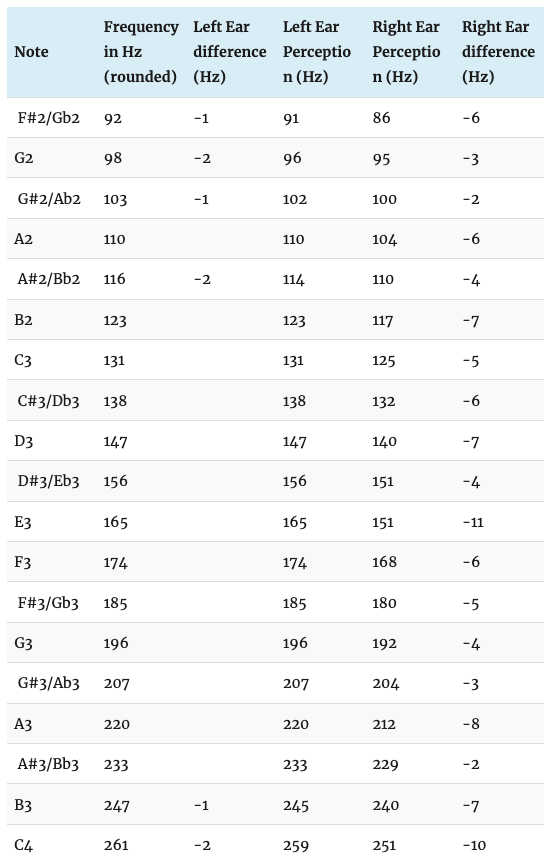
What we can see quite clearly from this is that my diplacusis is active at all frequencies, but also variable. For some pitches, it is more than a semitone. For others, rather less. I hear these two pitches combined, with the out-of-tune one being softer than the in-tune.

To go beyond my singing range required refence to my audiogram, from which it is clear that my right ear (in red) is a long way below my left ear. The left ear has normal hearing (above 10dB) in the region between 1500 Hz and 4000 Hz, which is my useful in speech situations, but there is quite a lot of hearing loss around that just the same. Nevertheless, my pitch perception in that ear is tolerable. Notice also that the lower frequencies show a marked decline in both ears. This is typical of Meniere's Disease, in which the bass disappears first. By contrast, in age-related hearing loss (presbycusis) the high frequencies deteriorate first, which is why so many hearing aids concentrate on the high end.
Working with this information took many months of struggle. I could no longer rely on my singing voice to help me understand my own pitch perception, because the rest of the piano keyboard is simply out of range. To make matters worse, every time I tried it was like working in a hall of endlessly reflecting mirrors. I would listen to my diplacusis with my diplacusis? it was very uncomfortable and very tiring. So with considerable effort, I worked on trying to understand my own hearing by feeling my way with trial and error. Gradually a number of key features emerged:
- There is an octave between F#5 (~698Hz) and F#6 (~1397Hz) where there is no diplacusis at all. In other words, I hear a piano just like a normal piano, as anyone else would, albeit with greatly reduced hearing in one ear.
- In the range above that, the diplacusis gradually reappears, getting worse the higher up you go. However, since the piano sounds pretty metallic in that register anyway the effect is not as disturbing as you might expect.
- The range from C4 (~261Hz) down to F2 (~87Hz) is affected by unpredictable amounts of diplacusis as per the chart from the earlier study.
- Below E2 (~82Hz) this unpredictable diplacusis effect continues, but now a new phenomenon enters, presumably resulting from the general loss in low frequency hearing.
- The fundamental frequencies of each note and then the first and second partials, gradually disappear, leaving a thudding sound and a collection of higher overtone frequencies. This complex spectrum is then subject to precisely the same diplacusis that affects the higher register, resulting in a perceptible shift in spectrum but no discernible change in pitch.
Given the difficulties of translating the above into any kind of instrument, I eventually had to seek help. I worked with Professor Craig Vear in the Courtyard Studio at De Montfort University. The result was the Diplacusis Piano
It is immediately clear that this is not really a piano at all, despite having piano sounds as its raw material. If I play a common chord, or attempt to play some classical piano music, all one hears is an out-of-tune piano. It's a bit like a honky-tonk but worse - some kind of abandoned instrument. Interestingly, the brain filters out the rubbish from the signal and quickly the out-of-tune-ness recedes into a normal piano.
So, to avoid sounding like I'm just trying to write piano music for a bad instrument, I had to find a new way of thinking about composing for this diplacusis piano. This echoes my experience with diplacusis and hearing loss generally. I need to find new ways of listening if I am to appreciate and enjoy music now. My aim is to create something beautiful, despite the supposed limitations imposed by my condition.
Craig was keen to describe how each note, each adjusted sample, made a different sonic journey lasting 10 seconds. What he could hear was a fascinating mixture of rhythmical beats, emerging harmonics, clusters of partials, percussive noise, all evolving over time. Every single note has its own character, which he was able to describe to me in some detail, waving his arms expressively as he did so. So this is not a piano, but rather an 88-note composition with a total duration of just under 15 minutes. The problem is, of course, that I cannot hear them. To me, each sample lasts about 3 seconds, and I do not trust what I hear even within that time frame. So, how could I possibly write music for this instrument if I cannot hear it properly?
Once again, new digital technologies came to my aid. During the building of the instrument, I removed my GNResound Linx Quattro hearing aids hearing aids, so as to capture as accurately as possible my diplacusis. Now, by reinserting them, I could gain a much better impression of the sounds of the instrument. I could hear them for longer and understand some of the complex shifting interactions between the higher partials. However, the hearing aids alone were insufficient, especially in the lower registers. Even with my unvented mould, which prevents sound escaping from my right ear, the low-end response was not enough.
As we worked on the instrument, we used a spectrogram to understand what was happening in each sample. This was fascinating, because it conveyed rich information about each note's story, showing the strange rhythmic pulsations that arise from beats, the emergence and withdrawal of various overtones, the intensity of different registers, and so on.
So, my way of composing became clear: I familiarised myself with the story that each of these 88 mini compositions tells. Then I could string them together in ways which created a convincing musical narrative. To understand how this works, you should view the video versions of each piece. These comprise two components: a Lissajous sound-field display and a real-time 3D or 2D spectrogram, realised in the Izotope Insight 2 environment. I used these spectrograms in two main ways: precisely, in order to connect up overtones to form a sequence, and impressionistically, to convey the general character of the music.
The first performance on the Diplacusis Piano was given by myself at the Old Barn, Kelston Roundhill, near Bath, UK, on July 6th 2019, as part of the first 'Aural Diversity' concert (see http://auraldiversity.org). I had composed an extended piece lasting ten minutes and played it with the spectrogram rolling across screen in real time. Two things emerged from this experience: the piece itself lacked shape due to the challenging nature of the material and it was extremely tiring both to play and to listen to. Reflecting on this led me to the short forms of the Thirty Minutes, which even include a silent movement to give the ears a forced ret. This version was performed in to 15 minute segments as an installation during the second 'Aural Diversity' concert at the Attenborough Arts Centre, University of Leicester, on November 30th 2019.
Conclusion
To create something beautiful from something as challenging as diplacusis is extremely difficult. However, it is, in my opinion, also necessary. Many composers and musicians have grappled with hearing problems, and there have even been attempts to convey distressing symptoms such as tinnitus in music. However, I believe this is the first attempt to map scientifically a person's hearing loss to a musical instrument and produce unique and distinctive musical compositions as a result. This is a creative response to adversity which also advances our scientific understanding of what has heretofore been a relatively under-researched topic.
References
Chasin, M. (2019). 'Hearing Health Matters: A Northwestern Study on Diplacusis'. Retrieved from https://hearinghealthmatters.org
Di Stadio, A.; Dipietro, L.; Ricci, G.; Della Volpe, A.; Minni, A.; Greco, A.; De Vincentiis, M.; Ralli, M. (2018). 'Hearing Loss, Tinnitus, Hyperacusis, and Diplacusis in Professional Musicians: A Systematic Review'. Int. J. Environ. Res. Public Health 15, 2120.