Virtual Vauxhall Gardens was a multidisciplinary project to create a multi-sensory, user-controlled, VR reconstruction of the experience of Vauxhall Gardens in 1752.
Vauxhall Gardens was re-launched in 1732 as the first and most significant of the true Pleasure Gardens of Georgian London. Commercial pleasure gardens, an English invention, were privately-run sites of entertainment; they were often situated on the outskirts of large towns or cities, and paying visitors were entertained in the summer months with music and company; refreshments were available at a price. Pleasure gardens, as their name implies, were mainly outdoor spaces, though sometimes with an assembly room or concert hall, and they were normally open in the evening, after the working day; anybody who could afford the admission price and who was at least respectably dressed would be admitted.
In re-creating this experience, we aim to widen access to and diversify audiences for historical virtual reality environments by engaging the widest range of senses (sound, vision, smell), using creative approaches and targeting non-traditional VR users.
Background
The idea of a VR reconstruction was first proposed by Lars Tharp and David Coke to Andrew Hugill (Professor of Creative Computing, University of Leicester). David’s compendious book on the subject had also provided the basis of an exhibition at the Foundling Museum, Bloomsbury, in 2012.
Hugill set about assembling a multidisciplinary team to develop the idea. In late 2018, funding was secured from the university’s Knowledge Exchange and Enterprise Development Fund (KEEF) and from the Leicester Institute of Advanced Studies to support the creation of an initial model of the Rotunda (pictured below).
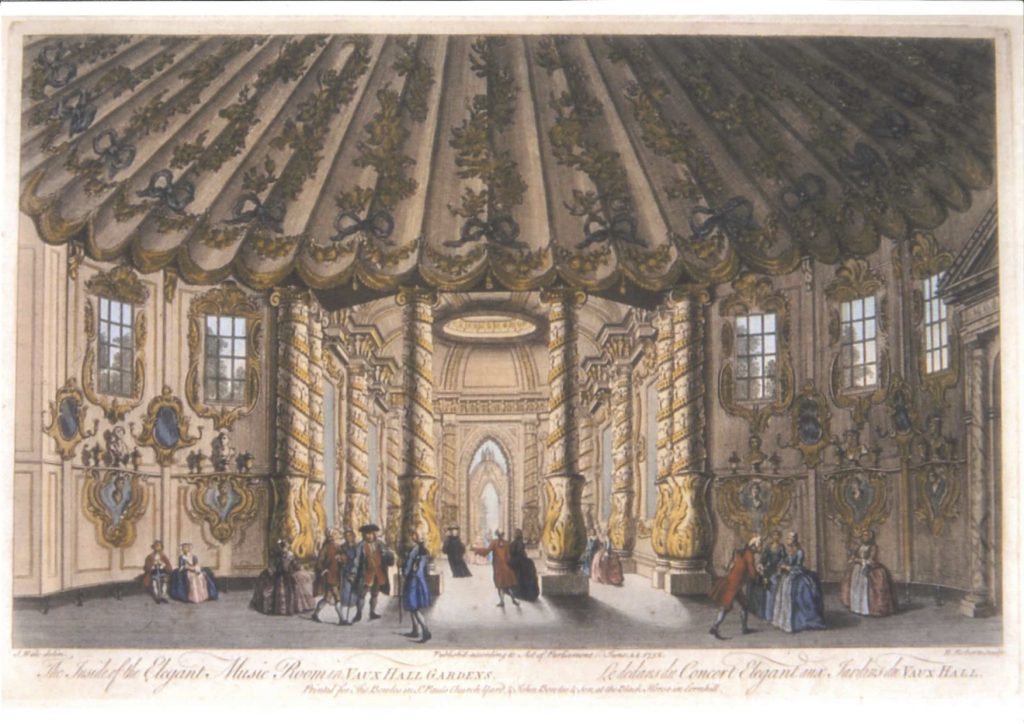
Interior of the Rotunda
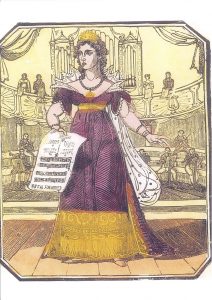
A singer in the Rotunda
The Rotunda was the main hub of entertainment: an indoor space that saw artistic exhibitions and musical performances as well as providing many opportunities for social interaction.
Exhibition
The completed VR model was shown at a well attended exhibition in the Attenborough Arts Centre, Leicester in July 2019. The exhibiton was reviewed by Vauxhall History Online. Users were invited to experience the VR by wearing headsets, one of which was also adapted to include the smell of burning beeswax that was released when the chandelier was lit.
As well as the VR experience itself, an informative slideshow provided historical bakcground and images, and a series of posters gave information about the creation of the model and the various analytical and research methods that were adopted.
Later in the year, the project was awarded "Research Team of the Year" at the 'Disovering Excellence Awards', which was a considerable recognition.